Hidden markov modeling of emotional state transitions in interactive installation art
Key findings and interpretation
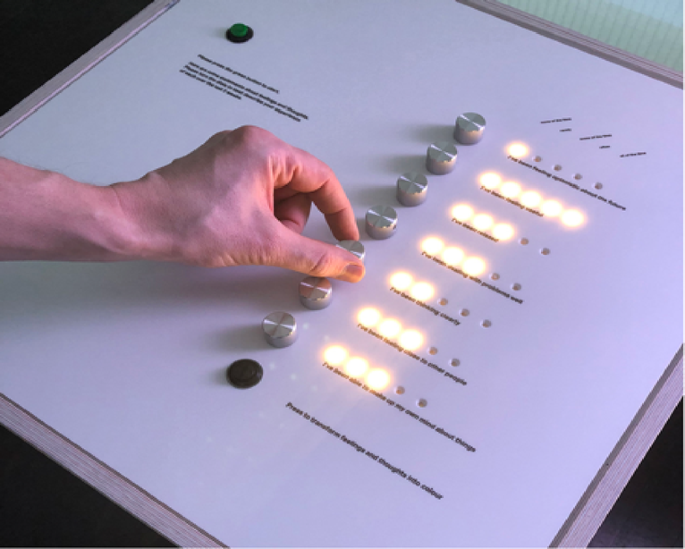
This study applied Hidden Markov Models (HMMs) in an exploratory, population-level manner to infer latent affective configurations in the HappyHere interactive installation. Although the dataset was cross-sectional, the HMM framework added value by revealing probabilistic differentiation patterns, stability, and long-term convergence among emotional states. Four key findings emerged, corresponding to the hypotheses proposed.
First (H1: Differentiation), the HMM identified three qualitatively distinct latent states. Descriptive comparisons indicated that State 1 consistently showed the lowest scores across all indicators (e.g., optimism M = 1.63), State 0 reflected intermediate values (optimism M ≈ 3.55), and State 2 was marked by uniformly maximal scores (all items = 5.0). Analyses of entropy further indicated that neutral/mixed states were less cohesive than positive states, supporting their psychological interpretability rather than implying arbitrary statistical clustering.
Second (H2: Stability of Positive States), the transition matrix revealed that positive states possessed the highest self-transition probabilities (≈ 0.80–0.88), with bootstrap confidence intervals confirming the Robustness of these estimates. Dwell-time analyses further showed that participants Remained in positive states for an average of 3.4 steps, versus 1.8 steps for neutral and 1.3 for negative states, underscoring their greater persistence.
Third (H3: Instability of Neutral States), neutral states exhibited the lowest self-transition probability (≈ 0.09) and showed a directional tendency to transition toward positivity. Their higher entropy values supported the interpretation that neutrality functions as a transitional rather than a stable configuration and is particularly susceptible to dispersion under contextual influences.
Finally (H4: Prevalence of Positive States), the analysis was Restricted to morning and afternoon submissions because the installation entered Replay-only mode after closure, and no valid evening data were collected. The stationary distribution converged strongly toward positivity, with positive states accounting for 86.3% in the 7-feature, full-covariance model, and this pattern was robust across alternative model specifications. A chi-square test comparing morning and afternoon distributions was statistically significant, χ²(2, N = 6,560) = 8.20, p = 0.016. However, the effect size was negligible (Cramer’s V = 0.04), indicating that the predominance of positive affect remained stable across time bins despite minor diurnal variation.
Comparison with prior research
Beyond confirming these hypotheses, our findings reveal important extensions to prior research on emotion dynamics across psychology, social media, and cultural contexts.
Differentiation of latent states. Identifying three qualitatively distinct states is consistent with a substantial body of theory and meta-analytic work indicating that emotions are not arbitrary statistical clusters but rather psychologically interpretable patterns. Houben et al.10 further demonstrated that variability and instability in negative affect are consistently associated with diminished well-being. Fredrickson22 argued that positive emotions broaden cognition and consolidate distinct experiential profiles. Similarly, Kang4 showed that joy, sadness, and fear could be reliably detected using HMMs in video content, underscoring the feasibility of linking low-level indicators to meaningful affective states. By recovering a three-state structure in a participatory art setting—moderately positive, low/negative, and highly optimistic—our results extend these distinctions beyond laboratory or media-based contexts and demonstrate their salience in public cultural environments.
Stability and instability of states. The observation that positive states displayed the highest self-transition probability and longest dwell times aligns with longitudinal findings indicating that positive emotions are more durable than negative ones. For instance, Cohn et al.30 found that daily positive affect predicted increased resilience and life satisfaction. Rand et al.31 reported that positive affect facilitates cooperation even when negative affect is statistically controlled. Fredrickson’s broaden-and-build theory posits that positive affect initiates “upward spirals” of persistence and resource building22. The present HMM-based analysis quantitatively formalizes these claims by estimating positive states as stable attractors in an interactive cultural context. In contrast, neutral states exhibited the lowest self-transition probability and higher entropy, corroborating prior research emphasizing their volatility. Li et al.32 observed that external events easily disrupted neutrality on social media, while Stroessner et al.15 showed that positive moods reduce perceptions of intergroup differences, suggesting that neutrality is unlikely to endure in socially salient contexts. Collectively, our findings provide probabilistic evidence that neutrality functions as a transitional rather than enduring configuration, consistent with work on affective variability highlighting the susceptibility of neutral or ambivalent states to fluctuation24.
Prevalence of positive states. The predominance of positivity in the stationary distribution is consistent with a broad literature on the protective and pervasive role of positive affect. For example, Yin et al.33 found that positive tweets outnumbered negative ones during the COVID-19 pandemic, while Cikara et al.17 showed that group contexts with weak competitive boundaries foster empathy and collective joy over hostility. Kuranova16 similarly conceptualized Resilience as the speed of emotional recovery, with positive dynamics Linked to Reduced psychopathology risk. By quantifying long-run equilibria in the 86.3% range, this study formally estimates emotional attractors in a participatory art environment, providing one of the first empirical demonstrations of positivity as a dominant equilibrium in cultural practice.
Notably, the results highlight not only the durability and dominance of positive affect but also the volatility of neutrality and the transience of negative states. At the same time, they extend the field by integrating probabilistic modelling with participatory art and providing robust quantitative evidence for the persistence of positivity across model specifications and temporal contexts.
Contributions and novel insights
While this study’s findings align with prior literature emphasizing the durability and prevalence of positive affect, they also yield several novel contributions that extend existing knowledge.
First, the empirical context is distinctive. Previous investigations into affective dynamics have primarily focused on laboratory experiments22,30, social media analyses32,33, or educational environments. In contrast, this study applies probabilistic modelling to data collected from a participatory public art installation (HappyHere), demonstrating that positivity and resilience theories also manifest within cultural and aesthetic settings. Second, the HMM uncovered a three-state latent structure rather than a binary model. Beyond a low/negative state and a highly positive state, a moderately positive configuration emerged as a stable attractor, whereas the highly positive state functioned as a rarer “ceiling effect.” This tripartite structure affords a more nuanced interpretation than conventional binary valence frameworks. Third, the analysis quantified long-run attractors. Although broad-and-build frameworks describe “upward spirals,” prior work Rarely estimates equilibrium. Here, stationary distributions Revealed that positive states accounted for 86.3% of the long-term equilibrium, offering one of the first attractor-based quantitative estimates in a public art context. Fourth, robustness was established across model specifications and temporal bins. Despite minor differences between morning and afternoon submissions, effect sizes were negligible, underscoring the stability of positive dominance across conditions. Finally, the analysis clarified the role of neutrality. Neutral states exhibited the lowest self-transition probability and higher entropy, functioning as transitional rather than stable configurations. These findings reframe neutrality not as a midpoint on a single continuum but as a passage toward positivity.
These contributions advance affective science by integrating probabilistic modelling with participatory cultural practice, yielding new structural, quantitative, and contextual insights into population-level emotional dynamics.
Theoretical implications
The results can be interpreted within the interdisciplinary framework introduced in Sect. 3, which integrates computational modelling, psychological theories of affective stability, and interaction design.
First, population-level HMM modelling illustrates the utility of probabilistic frameworks in revealing hidden structures of collective emotion. Even when applied to cross-sectional data, the model recovered differentiation, transition asymmetries, and long-run convergence, highlighting its potential as a structural analogue to temporal processes when actual within-person sequences are unavailable. Despite inherent limitations, adapting HMMs to cross-sectional population data provides a valuable tool for uncovering latent emotional structures that would otherwise remain obscured. Second, the predominance of positive states resonates with established psychological theory. The broaden-and-build framework13 posits that positive emotions accumulate cognitive and social resources, fostering resilience. The elevated self-transition probability and extended dwell time of positive states provide probabilistic support for this account. Conversely, the volatility of neutrality is consistent with prior evidence that ambivalent states are unstable and context-dependent32. Third, the installation context underscores the role of interaction design as an emotional regulator. Immersive, multisensory participation may reinforce positive affect and reduce the persistence of negativity, echoing earlier research on empathy and prosocial affect in interactive media19. Accordingly, the observed convergence toward positivity likely reflects both intrinsic affective dynamics and the moderating influence of designed environments.
These implications demonstrate how computational modelling, affective science, and design research can be productively integrated. They highlight the importance of interpreting emotional stability and volatility as emergent properties shaped jointly by individual tendencies and environmental affordances. These results are also consistent with prior work in art psychology, which shows that participatory and public art reliably elicits positive emotional engagement34,35.
Practical and design implications
Beyond theoretical and methodological contributions, the findings carry actionable implications for designing interactive systems and cultural experiences. Specifically, the observed stability of positive states highlights the potential of participatory art as a medium for emotional well-being. Installations can serve aesthetic purposes and operate as platforms that support resilience and cultivate collective positivity in public settings. Second, the transitional character of neutrality identifies specific design levers. Because neutral states are unstable and tend to drift toward positivity, designers can incorporate subtle cues—such as light-touch multisensory prompts or social affordances—to guide ambivalent participants toward more durable positive engagement. Third, the estimation of long-run attractors provides an implementable evaluation metric. Probabilistic models can assess whether specific design features (e.g., feedback loops, group density, sensory integration) shift the stationary distribution toward greater occupancy of positive states, thereby enabling evidence-guided iteration in cultural practice. Finally, the principles articulated here extend beyond the arts. Fostering positive stability, treating neutrality as transitional, and minimizing sustained negativity are guidelines that can inform the design of educational technologies, digital health systems, and urban public spaces. These applications underscore the broader role of interactive environments as affective regulators that support individual and collective well-being.
Limitations and future research
Several limitations temper the present findings. First, because the data are cross-sectional. While HMMs can approximate population-level structural tendencies, they cannot substitute for actual within-person temporal sequences. Future studies should employ longitudinal or experience-sampling methods to test the persistence of the identified attractor states. Second, reliance on self-reports narrows the measurement bandwidth. Although the SWEMWBS items provide reliable well-being indicators, they cannot capture physiological or behavioral signatures of affect. Moreover, because these items are framed retrospectively over the previous two weeks rather than capturing momentary states, participants’ reports may incorporate broader life circumstances alongside the immediate installation experience. This retrospective framing further constrains the extent to which the specific influence of HappyHere can be isolated. Integrating multimodal data—such as EEG, heart-rate variability, or movement traces—would deepen the mapping of latent states. Third, the empirical context is limited to a single public installation. Replication across different installations, cultural settings, and design modalities is needed to assess generalizability; comparative Research should test whether positive attractors are universal or contingent upon specific design features. Fourth, model-specification choices may have influenced results. Although robustness checks showed convergence across 3- and 7-feature HMMs, alternative covariance assumptions or a different number of states may reveal further nuances; future work could adopt hierarchical or Bayesian HMMs to capture individual heterogeneity. Finally, causal interpretations remain tentative. The dominance of positive states may reflect psychological tendencies, installation features, or broader contextual factors. Experimental manipulations like altering sensory feedback or group density would help identify and isolate causal mechanisms. Sensitivity analyses confirmed that excluding these anomalous values (< 0.1% of entries) did not materially affect descriptive or inferential results, with differences in means and standard deviations < 0.01.
These limitations suggest the need for longitudinal, multimodal, cross-context, and experimental designs to consolidate the claim that positive affect functions as a stable attractor in participatory environments. Addressing these issues would strengthen construct validity for HMM-based analyses and clarify the boundary conditions under which positivity emerges as a robust equilibrium.
link